[Private Diplomatic Letter No. 9]
The Torn Constitution and the Silent War: Now is the Time for National Unification
– The Communitization Campaign of the Moon-Yoon-Lee Cartel and President Syngman Rhee’s Manual for National Salvation –
찢어진 헌법, 총포성 없는 전쟁, 이제는 ‘국론통일’이다.
Since the impeachment of President Park Geun-hye, the Republic of Korea has completely lost its constitutional legitimacy during the subsequent processes of regime change. From the legal standpoint of constitutional preservation, all administrations that have emerged since then are nothing more than unlawful entities exercising illegitimate power. Consequently, any reorganization of government bodies, as well as the enactment or amendment of laws driven by these regimes, must be deemed fundamentally null and void.
Recently, during a high-level consultative meeting between the government and the ruling party, the current Lee Jae-myung administration finalized a government reorganization plan aimed at abolishing the Supreme Prosecutors’ Office and establishing a new Public Prosecutors’ Office alongside a Major Crime Investigation Agency. Representative Na Kyung-won of the People Power Party fiercely protested this move, arguing that because the Prosecutor General is explicitly mandated under Article 89 of the Constitution, the Prosecutors’ Office constitutes a constitutional institution in a broad sense, making its dissolution a clear violation of the Constitution. Conversely, Representative Kim Yong-min of the Democratic Party of Korea countered by claiming that the prosecution is not a constitutional institution.
Upon evaluating this matter through the lens of the Constitution and the laws of the Republic of Korea, the Constitutional Preservation League concludes that this dispute goes far beyond a simple debate over institutional nomenclature or the scope of duties. Instead, it directly exposes a critical crisis concerning the fundamental legal legitimacy of the administrations that have held power following President Park Geun-hye.
In light of the current constitutional framework and the essence of the rule of law, the legitimacy of a specific regime and the lawfulness of any resulting state restructuring must be scrutinized with the utmost gravity and clarity from the perspective of safeguarding the foundational spirit of the Constitution. This is because any governing act of state, or the enactment and amendment of legislation, can only be validly established upon the bedrock of constitutional legitimacy.
If the process of acquiring power or the method of governance fails to fully satisfy constitutional values and procedural justice, the entire sequence of actions and legislative endeavors pursued by that regime cannot be recognized as legitimate. In other words, arbitrary attempts to manufacture laws or randomly alter government organizations shake the very foundations of the state, confronting an inescapable legal self-contradiction due to the inherent flaw of illegitimate ruling power.
In this context, the plan pushed by the Lee Jae-myung administration to abolish the Supreme Prosecutors’ Office and create a Public Prosecutors’ Office and a Major Crime Investigation Agency is an act of subverting the state and disrupting the constitutional order, directly violating the essence of state functions prescribed by the Constitution.
The explicit mention of the Prosecutor General in Article 89 of the Constitution demonstrates that the prosecution is not an ordinary administrative body that can be dismantled at any time by mere statutory law. Rather, it is a “constitutional institution in a broad sense,” granted independence and unique functions as a quasi-judicial body within the constitutional framework. Therefore, using the excuse that its specific scope of duties is delegated to statutory law to deny the fundamental nature of the institution—and allowing an illegitimate regime to arbitrarily alter its name and functions—is an extra-constitutional rebellion that distorts the spirit of the Constitution.
Furthermore, the establishment and operation of the High Office for Investigating Corruption Among High-Ranking Officials (CIO) is a representative example of unlawful legislation. It was hastily manufactured to meet the political needs of an illegitimate regime, failing to harmonize with the existing constitutional criminal justice system. These institutions, established by bypassing the principles of separation of powers and due process guaranteed by the Constitution, ultimately do nothing but exacerbate chaos within the rule of law.
Extraordinary restructurings of state institutions and the passage of bad laws, pursued by a regime lacking legitimacy for its own political ends, inevitably result in unlawful measures devoid of constitutional justification. To restore the constitutional order of the nation and preserve the rule of law for future national reconstruction, the bloated, extra-legal entity known as the CIO must be abolished. The citizens must rise to firmly defend the essence and independence of the prosecution system as intended by the Constitution, thereby resolutely re-establishing the fractured legal foundation.
However, the grim reality we face is that because these illegitimate regimes usurped the seat of the lawful president and seized control over all public authority within the state, it is virtually impossible to overcome this crisis through the domestic judicial system alone. The Constitutional Preservation League has realized the limitations of the domestic legal framework firsthand through more than 80 lawsuits and countless complaints, charges, petitions, and appeals. This realization has led us to look back at international treaties embedded within the constitutional framework of the Republic of Korea, specifically the ROK-U.S. Mutual Defense Treaty.
The concept of “war” is divided into regular warfare, marked by the sounds of gunfire and artillery, and irregular warfare, which assumes a different form. The regimes that took power after ousting President Park have consistently pursued pro-North Korea and pro-China policies. Their political strategy was, in essence, the “great undertaking” openly declared by Moon Jae-in—a communitization campaign aimed at the ruin of the Republic of Korea. The political cartel of Moon, Yoon, and Lee shared a common drive for national plunder, differing only in degree, which can be summarized into three categories: the division of national opinion, the destruction of national security, and the deterioration of state finances.
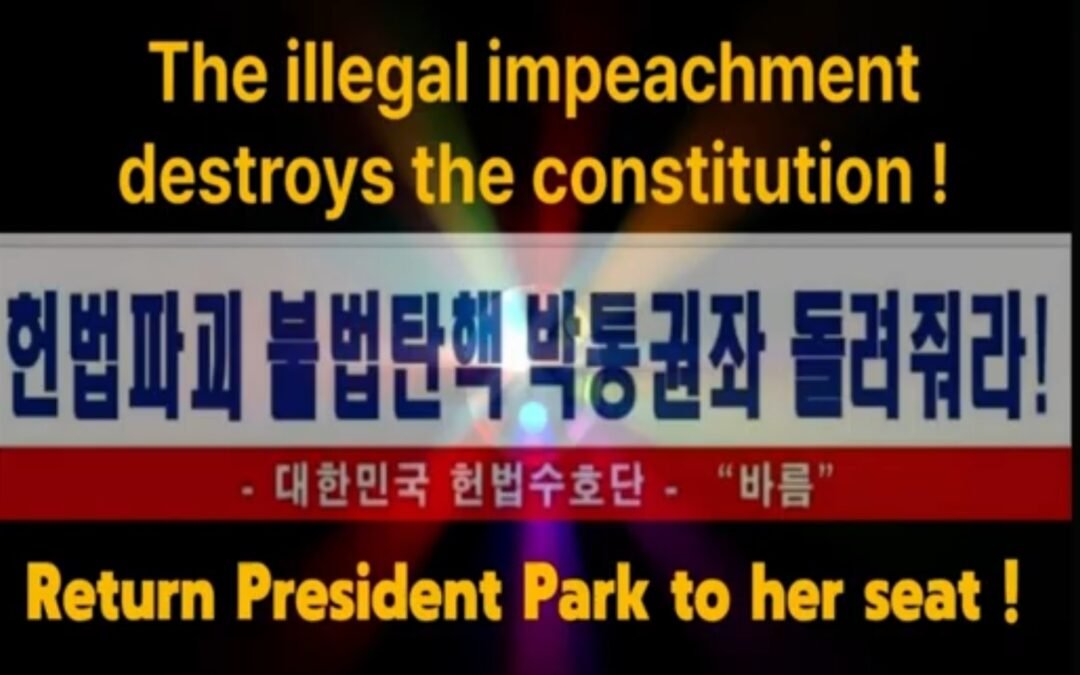
At this point, a significant portion of the public may still question, “Were Moon, Yoon, and Lee not presidents elected by the citizens through voting?” However, due to the blatantly illegal impeachment orchestrated by the National Assembly and the Constitutional Court at the time, President Park Geun-hye was never lawfully removed from office. Therefore, there was no legal cause or justification to hold an presidential election to choose a new president while she remained in office. Due to this unlawful impeachment and the subsequent sequence of presidential elections, our citizens have foolishly been living under an illegal, unauthorized rule, mistaking it for a legitimate government.
This illegitimate ruling power has disguised itself to appear as a normal exercise of governance to the public, acting as a silent, irregular war. They are currently in the final stages of completing their communitization campaign, using their arbitrarily enacted and amended bad laws as tools. Consequently, the Constitutional Preservation League found a solution for national salvation by bridging the concept of ‘war’ with the ‘ROK-U.S. Mutual Defense Treaty.’
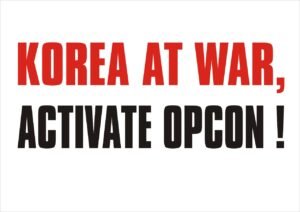
This is why we have recently been issuing successive ‘Private Diplomatic Letters,’ urgently calling upon our ally, the United States, to activate wartime operational control to save the Republic of Korea. In this manner, the Constitutional Preservation League rejects the unconstitutional, ruinous attempts of an illegitimate power, aligning its steps toward national salvation with our ally under the framework of the Constitution.
We solemnly resolve and declare that we will eventually abolish the CIO, fully protect the Supreme Prosecutors’ Office, and restore the constitutional order of the nation. Beyond a mere debate over institutional systems, this is an inherent historical duty borne by the citizens to rectify constitutional legitimacy and defend liberal democracy.
President Syngman Rhee once preached, “United we stand, divided we fall.” In the urgent crisis of the Korean War, he saved the nation by calling upon the UN forces. Going further, he secured a robust ROK-U.S. Mutual Defense Treaty, ensuring that future generations could save the nation without facing insurmountable hardships.
Now that we realize we have been plundered over the past nine years through the division of national opinion, the destruction of security, and the deterioration of finances, it is time for a unified national opinion to defeat the enemy.
May 27, 2026