[Civil Diplomatic Letter No.17]
Defending South Korea’s Constitutional Continuity and the Legal Integrity of the ROK-US Alliance
대한민국의 헌법적 연속성과 한미동맹의 법적 안정성 수호
- The Existential Crisis of the Korean Peninsula under Expanding Hybrid Warfare
The security crisis currently facing the Republic of Korea (ROK) shifts far beyond mere geopolitical fluctuations. The nation stands in the dead center of a “silent, non-kinetic Hybrid Warfare,” where ideological subversion, electoral manipulation, and deceptive peace offensives are deeply embedded beneath the surface of formal administrative power. The systematic erosion of security capabilities inherited from previous administrations, coupled with severe national division and fiscal destabilization, directly threatens the institutional foundation of the ROK—the vital linchpin of the regional liberal democratic value alliance.
Under this existential threat to our nation, we, the patriotic citizens, affirm that the sole resolution to safeguard the core values of the ROK Constitution and restore the strategic synergy of the ROK-US alliance lies in the return of the lawful President and the normalization of effective military command. We hereby submit this strategic memorandum as a civic diplomatic communique.
- Constitutional Continuity and the Head of State’s Sacred Duty of National Defense
Article 66, of the ROK Constitution explicitly mandates: “The President shall have the sacred duty to defend the independence, territorial integrity, and continuity of the State, and to uphold the Constitution.” The past impeachment and removal of President Park Geun-hye—driven by fraudulent deception, a temporary distortion of the Rule of Law, and mob intimidation—lacked procedural justice and is legally void ab initio (null from the beginning).
The circumstances under which the Commander-in-Chief was subjected to investigation, prosecution, and imprisonment cannot be interpreted as a voluntary relinquishment or self-acknowledgment of constitutional authority. Rather, it constitutes a non-genuine expression of intent induced by fraud.
Therefore, the sacred duty of national defense bestowed by the citizens and the Constitution remains an absolute obligation that can neither be severed nor extinguished for even a single moment. The Commander-in-Chief is not a mere former politician, but the living symbol of sovereignty guaranteeing the continuity of the State. As such, there exists a sacred and solemn obligation to represent the nation and return to the apex of the military chain of command.
- The Historical Origin of Operational Control and the International Legal Context of Collective Security
The historical origin of entrusting the operational control of the ROK Armed Forces to a combined allied system transcends the literal interpretation of treaty text. It is rooted in the exchange of official letters on July 14, 1950, during the early stages of the Korean War, between founding President Syngman Rhee and UN Supreme Commander Douglas MacArthur (commonly known as the “Daejeon Agreement”). In his official letter, President Syngman Rhee explicitly stated: “I am happy to assign to you the command authority over all land, sea, and air forces of the Republic of Korea during the period of the continuation of the present state of hostilities.“
As this historical document conclusively proves, the core essence entrusted by the Republic of Korea was not a superficial level of control, but substantive “Command Authority,” and its duration was strictly defined to last “during the period of the continuation of the present state of hostilities” (the wartime and quasi-wartime system).
Crucially, the Korean Peninsula remains under a state of a “legal quasi-wartime system” governed by the Armistice Agreement, as the war has never been internationally and legally terminated. Thus, the ROK military’s operational control is not individually subordinate to a specific nation; rather, it is a historical reality aligned with the United Nations system and international legal consensus established to manifest collective security. The ROK-US Combined Forces Command (CFC) system, established in 1978, is likewise a command structure built on mutual respect, driven strictly by joint directives agreed upon equally by the National Command and Military Authorities (NCMA) of both the ROK and the United States.
- Warnings Against False Dichotomies and Resulting Disruptions in the Chain of Command
We issue a stern warning against becoming consumed by superficial and false dichotomies—specifically, the pedantic debate over “Operational Control (OPCON)” versus “Operational Command.” Such futile conceptual disputes blind us to the true essence of the alliance and risk paralyzing the military. A command debate confined entirely to domestic political agendas, while completely ignoring military-diplomatic pragmatism and Legal Due Process, serves only to degrade the trust of our ally.
The operational rationale for the United States and the ROK-US CFC rests entirely upon international legal legitimacy and treaty integrity. If we deny the historical continuity and legal legitimacy of our military command structure in favor of a subjective, politicized narrative, our ally may well reserve military intervention during a crisis due to a lack of legal basis and procedural uncertainty. Because the core of any military is an uninterrupted, substantive Chain of Command, any debate that disregards the established nature of the ROK-US combined defense system will inevitably trigger catastrophic breakdowns in command communication and cause an irreversible security vacuum in times of crisis.
- Rationale for Strategic Cooperation with the United States and the Activation of the Combined Defense System
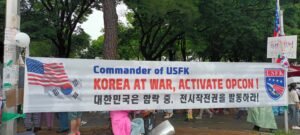
Based on the ROK-US Mutual Defense Treaty, we have actively engaged in civic diplomacy to persuade Washington and build consensus within the US Congress, while securing a strategic foothold through the institutionalization of ROK-US-Japan trilateral security cooperation. However, for the United States and the ROK-US CFC to recognize the peninsular hybrid crisis as a state of war and fully activate the combined defense system, a lawful ROK Commander-in-Chief possessing international legal legitimacy must stand at the forefront.
The United States is a nation governed by laws that holds “Principles and Procedures” as absolute values. Subjective assertions alone cannot move the wheels of the alliance’s war machine. The Korean Peninsula remains in a legal state of quasi-war under the Armistice Agreement. The strategic rationale that “the sole Commander-in-Chief who inherits the legal legitimacy of the combined defense system seeks to normalize the military chain of command and fulfill allied obligations” will serve as the most powerful international legal argument—one that the US Executive Branch, Congress, and the Combined Forces Command cannot refuse. When this undeniable legal legitimacy is brought to the fore, the United States will gain the necessary legal and political justification before the international community and its own Congress to decisively execute its mutual defense obligations and secure the stability of the Indo-Pacific region.
- A Resolute Decision for National Salvation and the Defense of Liberal Democracy
Any assessment addressing the operational control and command of the ROK military must be preceded by an interpretation that clearly recognizes the historical reality of the UN military’s operational control establishment during the Korean War and the fundamental nature of the combined defense system. Without this, no sound rationale for national salvation can exist. Excluding this historical fact and approaching the issue through emotional or purely conceptual arguments will only create a fatal obstacle, rendering operational command and control dysfunctional on the actual stage of international politics and military diplomacy.
In a hybrid security crisis where the survival of the state hangs in the balance, constitutional legitimacy and military command are an inseparable, single entity. When the legitimacy of the lawful Commander-in-Chief granted by the Constitution stands firm at the forefront, the ROK Armed Forces will finally find their true leader aligned with their historical origins, and our ally, the United States, will seamlessly operate the promised mutual defense treaty system without hesitation.
Our objective is not merely to restore the past honor of President Park Geun-hye. Our solemn calling imposed by this era is to rebuild the broken Rule of Law, safeguard the legal integrity of the ROK-US combined defense system, and restore the liberal Republic of Korea to a path of sustainable prosperity.
We will organize and unite as a highly visible, robust entity within the territory of the Republic of Korea to defend the values of liberal democracy, serving as a massive bulwark of public consensus that proclaims this legal legitimacy to the world. Therefore, for the grand future of a free nation, we seek to save a crisis-ridden Republic of Korea and its Constitution in close solidarity with our ally and free partner nations.
■ Direct Appeal and Proclamation to the Commander-in-Chief
Madam President Park Geun-hye, when a nation faces an existential crisis, the decisive resolve of the Commander-in-Chief becomes the sole beacon of salvation for the country. We implore you to strictly execute the ultimate authorities and responsibilities bestowed upon you by the Constitution, and proudly proclaim this legal legitimacy to the entire world.
We will organize as a visible, powerful force within the territory of the Republic of Korea to restore constitutional values, proving a massive wave of public opinion and consolidated strength to back your command. When you, as the lawful Commander-in-Chief, confidently issue the order, the ROK Armed Forces will find the leader that matches the justice of the Constitution and their historical origin. The United States, our steadfast ally, will also smoothly activate the promised mutual defense treaty system. We earnestly urge your courageous and resolute decision for national salvation to save our endangered fatherland and its Constitution.
June 25, 2026
Constitutional Guardians Alliance (CGA)
of the Republic of Korea
Representative Park Sang-gu
Institute for National Prosperity and Power (INPP)
Director Kim Dae-heung
Presented by the ROK Civil Diplomacy Intellectuals Solidarity for the Defense of Liberal Democracy and Constitutional Order