[Opposite the Editorial Page (Op-Ed)]
June 3rd Fraudulent Election Is an Act of Betrayal against Constitutional Justice: – There Is No Democratization Without Substantive Guarantee of Sovereignty –
6.3. 부정선거는 헌법적 정의의 배신행위:
– 실질적 주권 보장 없이 민주화는 없다 –
The Hollowing Out of the Principle of “Higher Law First” and the Evils of the Proviso of the Public Official Election Act (Article 224) Under the Guise of Outcome-Determinism, Which Is Quite Uncomfortable for the Rulers to Hear, But Citizens Must Absolutely Know as Citizens.
Article 224 of the Public Official Election Act (Judgment, etc. on Nullity of Election): The Election Management Committee, the Supreme Court, or the High Court that has received a petition or a lawsuit shall, even where there is a fact violating the provisions concerning an election in an election dispute, decide or judge the nullity of the whole or part of the election or the nullity of the election of the winner, only when it is recognized that such violation has affected the result of the election.
I. Introduction: The Perilous Inversion (顚倒) of Constitutional Ideals and Subordinate Norms
Article 1, Paragraph 2 of the Constitution of the Republic of Korea prescribes that “The sovereignty of the Republic of Korea shall reside in the people, and all state authority shall emanate from the people.” This solemn declaration means that the legitimacy of all state actions must originate from the will of the sovereign populace, and to guarantee this, the legal system takes the ‘Principle of Higher Law First’ as its grand premise.
This principle is not a mere technical hierarchy system, but the minimum safety device of democracy that binds subordinate norms so that they cannot betray the essential value and ‘justice’ of the Constitution, which is the supreme norm.
However, today, the legal application and legislative reality of our society are flowing backward, forgetting this fundamental principle. Even in the election, which should be the most sacred exercise of sovereignty, an act of bypassing constitutional justice is occurring by putting forward the proviso clause of the Public Official Election Act, “when it does not affect the result of the election (limitation of grounds for nullity in lawsuit procedures, etc.).”
This is a representative proof of the ‘hollowing out of norms (= emptying, 空洞化),’ in which subordinate norms invert and practically neutralize the spirit of higher norms.
This editorial excludes the shallow realism of the rulers hiding behind the pretext of preventing national paralysis, completely dissects the evils in legal theory and common sense caused by the forgetfulness of the principle of higher law first, and intends to present a fundamental methodology to reform the reality of fraudulent elections revealed in the 6·3 local elections.
II. The Evils: Legal Technocracy Wearing the Mask of Realism
1. The Realism of ‘Legal Stability’ That Exposes the State’s Dereliction of Duty
The rulers who defend the proviso clause of the Public Official Election Act put forward ‘Legal Stability (State Continuity)’ as a pretext, arguing that we must prevent national vacuum or administrative paralysis, and the grand scale and technical limitations of modern elections.
In this argument, first, the attitude of the courts, which have served as the chairmen of local election management committees at each unit, followed by the attitude of the courts showing through judgments in election lawsuits, is exactly like that. And, the behavior of the ruling and opposition politicians, which is invariably showed this time without fail, is consistently identical; since when did the ruling and opposition parties, pursuing legal stability from national vacuum or administrative paralysis, seek combined politics for the country and the people?
It is an excuse for a realistic compromise of a ruinous ‘second-company’ nature, stating that rather than the status of the elected official becoming unstable for a long period due to reckless lawsuits by the defeated candidate’s camp, confirming quickly even a ‘less-than-perfect elected official’ complies with the interest of the community.
However, this logic paradoxically confesses the state’s fatal lack of capability and dereliction of duty. Stating that we cannot nullify an election under the pretext of ‘national confusion’ even though there was insufficiency, slipshod management, or illegality in election administration is no different from the state itself confessing, “We do not have the ability to execute the law perfectly, and we will not take that responsibility either.”
As a result, this has brought about the normalization of an immunity for illegality to the election management bodies and rulers, whispering: “As long as you do not give a fatal vote difference in the result, it is okay to manage roughly, or even use a bit of strategic trickery.”
However, despite the fact that there is a bigger contradiction that our Republic of Korea has right now, most citizens do not know this, and the rulers who know the fact are all pretending not to know, which is a much bigger, weightier, and serious problem.
2. Self-Serving Focus Only on the One Mind of the Ruinous ‘Grand Design’ of Communization 공작(Sabotage)
‘Grand Design (大業)’ is a word that Moon Jae-in emphasized at a Democratic Party event where he shared his unfulfilled ambition with party members even after finishing his 5-year governance.
For all living things that have life, satisfying the reproductive basic desire is the top priority. For humans as well, the priority value of ‘eating’ and ‘democracy’ will have the solution for ‘eating’ as the top priority, regardless of time and space, gender or age, wealth or status.
If one cannot be liberated from ‘eating,’ freedom, democracy, and other pleasures of satisfying the five senses have no choice but to be secondary; only from the solution of hunger, one finds the spare time to look for freedom, democracy, and dignity.
In the reality of our society right now where everyone was hungry after the extremely difficult Korean War, economically living well is not something that just happens as one wishes by just living ordinary life, which we realize through the stiffness of life experience.
At that time, the immediate war stopped, and the survival of the extremely difficult citizens in the days when disabled veterans from battle wounds and orphans were common had no choice but to be grass porridge and begging, so where could there be anything as urgent as the solution of hunger?
There were several leaders who were the main actors of economic development in this land, including President Park Park Chung-hee, who stepped forward as leaders to solve this pain of the people.
There was no capital to spark economic development, and it was a country completely devoid of seed money to do anything in a land without resources. In these conditions, with day and night agonizing and running east and west, the citizens dedicated themselves in foreign lands for their families back home to raise this country, yet the later generation citizens of this country label such a person as a ‘dictator’ and are deprecating him in reality.
A parent who taught a precious child with a rod was also a dictator, and in the military, in sports teams, that harsh training was also a dictatorship to them, so looking at it, aren’t all the sons and daughters of Korea the children of dictators?
If we become a communist socialist society completed by ruinous political strikes of labor unions and KTU ( 전교조) education, will ‘dictatorship’ be completely terminated from us? That is why they are called ‘Meong-min (懵民: ignorant masses).’
Trapped in the puppet ideological framework that designates only the great leader who freed them from hunger as a dictator due to wrong education, the Meong-min do not even know that they themselves are the sovereigns, and do not even know how to exercise that sovereignty, which is the breathtaking reality of the Republic of Korea today.
Is this the reason why a loyal dog that knows how to keep absolute faith is prettier than an existence called ‘human’ who is so foolish?
The contradiction of the so-called ‘democratization generation,’ who claim to have abolished the guilt-by-association system in this country, yet still publicly label his daughter as the ‘dictator’s daughter’ and continue historical bullying against her until now, is pitiful.
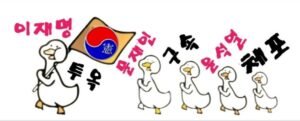
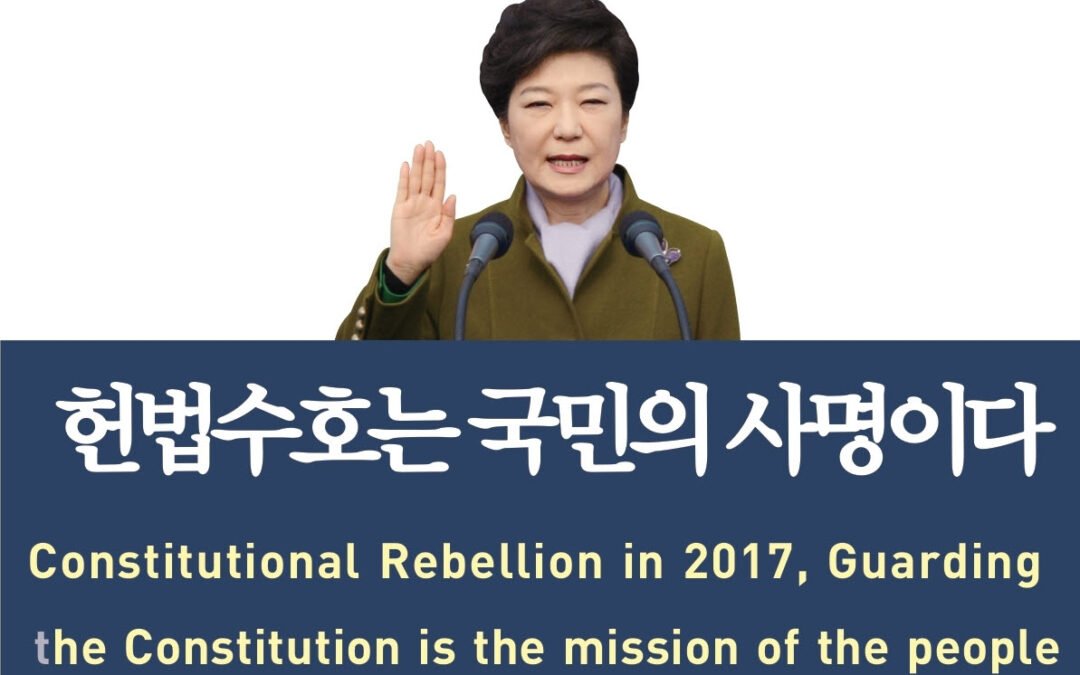
They oust such President Park Geun-hye from her throne unlawfully with the state’s constitutional organ hosting it—which is evidence that many spies have infiltrated the center of the country, yet they do not perceive this—and then they established an anti-constitutional illegal regime, and have been committing lawless governance for 9 years until now by deceiving the citizens.
Regarding this grave wrong phenomenon, not a single legal knowledge persona in this country mentions it, and illegality is being distorted into silence, so the moral conscience and constitutional order of our society are extremely unjust.
Since when did our society become a society living by throwing away conscience, and what on earth are we educating the later generation? We cannot help but ask this seriously, which is the life of the Meong-min living in a truly strange country.
3. The Judicial Advanced Post of Constitutional Subversion: The Vicious Cycle of Judicial Compromise That Tore Down Procedural Justice
When tracing the constitutional betrayal tied to fraudulent elections, we face the chronic disease of our judicial history that threw away the value of higher law and procedural justice and succumbed to ‘realism’ and ‘political compromise.’ Just like the principle of Won-tak-ryu-o (源濁流汚), meaning if the source is muddy the flowing water is also dirty, the illegitimate power and unlawful governing acts are nothing but Dok-su-dok-gwa (毒樹毒果: poisonous tree, poisonous fruit) grown in the forest where the judiciary itself closed its eyes to procedural legitimacy.
We have already witnessed the horrible full story through the illegal impeachment case that violated the constitutional order. The most fatal fuse that destroyed the higher law was precisely the past impeachment adjudication of President Park Geun-hye.
At that time, the National Assembly and the Constitutional Court ignored strict evidence-adjudication pragmatism, and exposed serious procedural defects crossing between the Constitution and lower laws, such as neglecting the configuration of the full bench and making a forced decision under the 8-member vacancy system. Even before the grave matter of dismissing the head of state, rather than defending the constitutional value which is the highest norm, they committed an unprecedented procedural illegality and major legal error in judicial history, tearing down the general principles of law by putting forward political realism called settling the situation.
This gigantic chain of illegality perpetrated solely for the result of ‘regime ousting’ while losing the righteousness of the process, later gave birth to an原인무효 (null and void from the beginning) power structure leading through the Moon Jae-in regime to Mr. Yoon Suk-yeol and Mr. Lee Jae-myung, and rapidly opened the passage of lawless governance spanning 9 years.
The price of ignoring judicial justice while leaving a dangerous precedent saying ‘even if there is procedural illegality, it is fine as long as we get the result’ is miserable.
Today, the Election Management Committee and the court can proudly wield arrogant legal technocracy, abusing the proviso clause of the Public Official Election Act to say “if it did not affect the election result, the corruption of the process can be condoned.” In the end, the past judicial compromise came back as poison, leading to a huge treasonous evil of constitutional subversion that retroactively cuts and neutralizes the votes of the sovereign people.
Myeong-bu-jeong-eon-bul-sun (名不正言不順), if the name is not proper, the words do not accord with reason, and in the end, the grand design of the regime cannot be achieved. It is a natural principle that illegal acts perpetrated under an illegal regime established without popular legitimacy and constitutional justification have no choice but to be used as tools of lawless governance.
A person whose source of power is muddy can never find the path reaching the hearts of the people. No matter how much the arrogance of the rulers and legal technocrats who mocked the Constitution pierces the sky, the solemn mesh of legal theory cast by history and the sovereign will never let them go.
4. Legal Evils: Destruction of Systemic Integrity and Unjust Shift of the Burden of Proof
Under this illegal regime, we recently witnessed a shocking disaster that should never happen in the election history of the Republic of Korea. It was revealed that at 67 polling stations nationwide, there were no ballots, so citizens could not exercise their normal voting rights.
Regarding this, the Election Management Committee laid out typical sophistry and excuses, calling it an “accidental temporary distribution mistake in some areas” or “those few thousand votes have no effect whatsoever on the overall election result or the winning or losing.”
Bringing out this contradiction of our society comes from thoroughly excluding the ‘Principle of Higher Law First.’
To evade the resistance that would collide with constitutional revision work, they make anti-constitutional and anti-higher law regulations as lower laws that hollow out (= empty) the Constitution to oust an innocent president, and use it as a tool by law plotting various ways of ruining the country, yet our society is already heavily rotten and sick with no lawyer pointing this out.
The treatment method for this is desperately in need of righteous condemnation based on legal common sense, which is possible through the help of world citizens who condemn the lawless Republic of Korea; this will be the unique, peaceful, and wholesome alternative to rescue the Republic of Korea.
When ignoring the principle of higher law first and putting forward the proviso clause of lower laws, the legal system experiences serious distortion. If the Constitution is a qualitative goal, lower laws must be the means to safely realize that goal.
However, the abuse of the current proviso clause destroys the legitimacy of the legal system by taking for granted the “legal contradiction where the means (Public Official Election Act) inverts the end (Article 1 of the Constitution, Popular Sovereignty).” This is because it excessively restricts freedom of expression and political fundamental rights by attaching the condition ‘as long as it does not affect,’ even though citizens’ political expression and participation inherently possess the character of intending to affect election results.
A more serious legal distortion occurs in the ‘unjust shift of the burden of proof.’ If there was a clear illegality in the election process, the state and the elected winner should rightfully prove the legitimacy of that election.
However, the current judicial logic rather places an impossible burden on the sovereign citizens and plaintiffs, demanding: “Prove mathematically and statistically what kind of impact that illegality had on the result.” This makes the judiciary retroactively cut the votes of the sovereign with subjective discretion, and it is a treatment that extremely alienates the sovereign legally.
5. Common Sense Evils: Endorsement of ‘Outcome-Determinism’ and Legal Cynicism
Law must be based on the common sense and general legal feelings of a universal community, but the shallow legal interpretation of the rulers seriously pollutes the citizens’ sense of justice. Even in a sports match, if a clear foul is detected, it is common sense to suffer a forfeiture regardless of the score difference or match result.
Heavily weighing on the election that decides the fate of the country, declaring that “there was serious foul play and slipshod management in the process, but because the score difference is wide, it is valid” is the state endorsing moral numbness and ‘outcome-determinism’ that says “it does not matter which way you go as long as you reach Seoul.”
Here, the ‘Legal Impunity’ of the rulers is strengthened. Ordinary citizens face immediate punishment and disadvantage even if they violate a very small duty to uphold the law (traffic regulations, taxes, etc.).
On the other hand, the rulers who hold power commit slipshod management and illegality that shake constitutional values, yet they preserve their seats hiding behind the grandiose pretext of ‘social stability.’ This extreme unfairness makes citizens give birth to deep cynicism toward the law, meaning a resignation of “Power brings innocence, Powerlessness brings guilt” that goes beyond the old saying “Money brings innocence, Pennilessness brings guilt.”
III. Methodology for Reform
1. Judgment and Disposition Regarding Post-Processing
① Normative Judgment on Whether to Conduct a “Re-election”
-
Shift from ‘Outcome-ism’ to ‘Process-ism’: The existing judiciary has judged whether to hold a re-election based on whether the illegal act was a vote difference big enough to change the winning or losing (quantitative evaluation). However, the moment a fraudulent election is discovered, the democratic legitimacy of that election is already extinguished.
-
Redefining the Criteria for Re-election: We must take as a standard not the simple ‘scale’ or ‘numerical value’ of the illegal act, but whether ‘the voter’s free formation of will and the secrecy/fairness of voting’ that the state must guarantee was essentially infringed (qualitative evaluation). Entrusting local administrative power and tax collection rights to a person elected through a corrupt process flatly contradicts Article 1 of the Constitution, so districts where serious procedural illegality is revealed rightfully must immediately declare the election void and conduct a re-election.
② Strict Disposition of Actors and Related Agencies
-
Criminal Punishment Harsher Than General Crimes: Election illegality must be treated as a treasonous crime that shakes the foundation of the state. We must apply arrest-based investigation for all individuals involved (conspiring candidates, illegal actors) without privileges of non-prosecution, and apply the maximum legal penalty.
-
Dismissal of Internal Officials of the Election Management Committee and Structural Clean-up: The officials of the Election Management Committee whose slipshod management or connivance was revealed must be ‘dismissed’ rather than facing simple discipline or demotion, and we must hold them responsible by strictly applying the crime of dereliction of duty.
-
Claiming Indemnity Rights for Re-election Costs: We must charge the enormous total cost of the re-election occurring due to the fraudulent election as a joint and several liability to the candidate who committed the fraud, the political party, and the election committee officials with intentional or gross negligence, claiming indemnity rights. Leaving a strict precedent saying “the price of fraud is bankruptcy” will establish the discipline of the rule of law.
2. Systemic Improvement Direction (Election Committee, Voting/Counting Procedures)
① Reorganization of the Public Election Management Body: Reopening the Election Committee at a Level of Dissolution and Multi-faceted Mutual Check
The current National Election Commission claims to be an independent organ under the Constitution, but it has self-invited controversies of slipshod management and fraud due to its centralized power structure, internal leniency, and human composition that watches the mood of the political camp. To realize constitutional justice, future public election management must be completely reorganized into the following form:
-
Reorganization into a Transcendental (超然的) ‘Independent Election Purification Committee (tentative name)’: We completely clean up the human composition of the election management subject, and completely exclude the political camp’s (President, National Assembly) nomination rights when configuring the committee members. Instead, we select committee members through strict qualification verification from non-partisan expert groups such as the Judiciary (Supreme Court Justices Council), academia, and the Korean Bar Association, thereby securing complete independence transcendental from power.
-
Strengthening Legal Control Centered on the Judiciary (Courts): The practical work of election management (installing polling stations, administrative support) shall be handled by the Independent Committee, but the exclusive authority to watch election disputes and illegality shall be completely transferred to the Judiciary (Election Exclusive Benches of courts at each level). If even a single sign of procedural illegality is captured during the election process, the court establishes a ‘Judicial Constant Control System’ that can immediately suspend election administration temporarily or issue a correction order.
-
Institutionalizing a Permanent ‘Pan-Citizen Election Audit Committee’ and Strengthening Inspection Rights: We institutionalize an independent auditing organ led by civil society and academia to audit the entire process from election preparation to the on-site counting on the election day in real-time, granting power to forcefully read administrative records. That is, completing the mutual check mechanism of a triangular formation leading from [Practical Management: Independent Committee] – [Legal Control: Judiciary] – [Real-time Audit: Civil Society].
② Restoring the Analog Justice of Voting and Counting Procedures (Strengthening Transparency)
-
Complete Re-examination and Reduction of the Early Voting System: We must drastically reduce the early voting period, which is the hotbed of fraudulent election controversies and the blind spot of management. Also, we legislate that the entire process of moving and storing early ballot boxes must be broadcasted in real-time 24 hours a day by civil inspectors through public internet open channels, not closed CCTV networks, fundamentally blocking distrust.
-
Legislation of the Manual Counting (手開票) Principle: Electronic equipment such as ballot sorters must be strictly limited to a ‘simple auxiliary tool.’ We mandate ‘100% total manual counting,’ where humans check directly with eyes and count with hands, as the main counting procedure. This is because the accuracy and transparent trust (ideal) are much higher values than administrative speed and efficiency (reality).
-
Strengthening Ballot Paper Security: We mandatorily introduce a blockchain-based serial number verification system, special ink, or watermark technology that makes forgery impossible into the ballot paper. Through this, we modernize the physical system so that even a single sheet of forged or externally introduced ballot paper can be immediately distinguished during post-verification.
3. Fundamental Amendment Direction of the Public Official Election Act
① Total Amendment or Deletion of the Proviso Clause (Article 224, etc.)
-
Amendment Direction: We must completely amend the current phrase “only when it is recognized that such violation has affected the result of the election” into “provided there are no serious procedural illegalities that harm the fairness of the election.”
-
Effect: Regardless of whether the vote difference is large or small, if it is an election that lost democratic legitimacy in the process, we can achieve the result of strictly restricting legal arbitrariness and discretion so that the judiciary ‘cannot close its eyes’ under the pretext of realism.
② Creating a New Provision for the Shift of the Burden of Proof
To smash the existing unreasonable judicial precedents that forced the sovereign citizens or lawsuit plaintiffs to mathematically and scientifically prove ‘the concrete impact this illegality had on the result’ in an election nullity lawsuit, we place an explicit regulation in the law.
We create a new ‘Provision for the Shift of the Burden of Proof’ stating: “If a clear procedural illegality is detected in the election process, the burden of proof that the election was conducted fairly and that there is no abnormality in the result lies with the Election Management Committee and the elected winner.” Through this, we correct the anti-constitutional legal distortion that alienated the sovereign citizens and turned them into losers.
4. Reflecting Improvements of Substantive Popular Sovereignty
The French thinker Jean-Jacques Rousseau once sharply criticized the limitations of the ‘formal and periodic exercise of sovereignty’ possessed by representative systems and elections, saying, “The English people are free only on the election day, and once the election is over, they become slaves again.” Stating that stamping a stamp on a piece of paper at a polling station once every few years makes it difficult to overcome the election law limitations of Article 1 of the Constitution, which states “All power emanates from the people.”
Therefore, going beyond the formal exercise of sovereignty called voting, we need institutional and practical methods to reflect ‘Substantive Popular Sovereignty’ where citizens constantly control power and participate in policy.
① Total Introduction of ‘Direct Democracy Elements’ for Constant Power Control
Even after delegating power through an election, a substantive system must be constitutionally and legally supplemented so that citizens can retrieve or control that power.
-
Expansion of the Citizen Recall System (국민소환제): When an elected public official in office (National Assembly member, local government head, etc.) acts against the will of the people or commits corruption/misgovernment, voters must be able to directly strip them of their office without waiting until the next election, guaranteeing the recall right as a constitutional right. This is the most powerful substantive control device that makes the rulers constantly watch the mood of the sovereign throughout their terms.
-
Citizen Initiative System (국민발안제) and Referendum System: We must activate a structure where important national policies or bills are not left as the exclusive property of the rulers alone, but if more than a certain number of citizens agree, they can directly initiate a bill to place it on the National Assembly floor, or finally decide national issues through a referendum.
② Combining Deliberative Democracy and Digital Public Squares
Going beyond a simple majority vote (formalism), a ‘deliberative exercise of sovereignty’ where citizens derive reasonable alternatives through sufficient information and discussion must become an everyday occurrence.
-
Legislation of Citizens’ Assembly (시민의회): We institutionalize a Citizens’ Assembly configured by random sampling (lottery system) so that citizens can directly deliberate and issue policy recommendations on difficult problems that the political camp cannot solve due to partisan interests, such as pension reform or electoral district reorganization.
-
Blockchain-Based Digital Direct Participation System: Utilizing modern highly advanced IT technology, we build a highly reliable digital public square where citizens can constantly express their intentions on major national agendas and the voting results are substantively reflected in policies.
③ Substantive Reform of Election and Party Structures
For the act of voting to become a substantive expression of sovereignty, a party/election ecosystem where the voters’ true intentions are reflected without distortion must be prepared.
-
Complete Realization of the Linked Proportional Representation System: We must smash the current system where giant giant ruling and opposition parties monopolize popular will and distort the votes through tricks like satellite parties. We must completely reform the election system so that the seats in the National Assembly are allocated exactly according to the support rate voted by the citizens, thereby substantively securing the value of the vote (등가성).
-
Establishment of Intra-party Democracy: We must abolish the structure where the nomination rights for party candidates are manipulated by powerful individuals or factions, and mandate a ‘Complete National Primary System (Open Primary)’ where local residents and party members directly elect candidates, thereby making popular sovereignty operate right from the stage of selecting public candidates.
IV. Conclusion: Return to Constitutional Justice and Process Justice
The proviso clause in the Public Official Election Act and the behavior of the rulers surrounding it are the pinnacle of a ‘shallow logical approach’ that hid behind local sentences of lower laws and administrative convenience because they were afraid to directly face constitutional ideals and justice.
In the end, restoring the analog justice of the election management system and abolishing the proviso clause of the Public Official Election Act is merely the ‘minimum defense line’ to recover the basic physical strength of collapsed democracy. The true realization of popular sovereignty is not trapping the citizens in the periodic formal exercise right of a few years called voting. It is completed by constitutionally restoring substantive participation mechanisms such as the ‘Citizen Recall System’ to constantly recall power in office, the ‘Citizen Initiative System’ to directly legislate laws, and a ‘Complete Linked Proportional Representation System’ that contains popular will without distortion.
The Constitution is not an auxiliary and ornamental sentence to be appropriately fitted when interpreting lower laws, but it must be the strict starting point and destination that controls all acts of state power and grants legitimacy.
Therefore, to secure constitutional legitimacy, we must essentially amend the proviso clause to separate simple administrative mistakes from structural fraud, and build a judicial system that prevents reckless lawsuits along with the shift of the burden of proof. Furthermore, we must transparently innovate the entire process of exercising sovereignty through analog system reform called abolishing early voting and on-site counting at polling stations, and reconstructing into an independent management body completely transcendental from political power, establishing a triangular check system of the judiciary and civil society.
Only the strict judicial and legislative reflection that clearly recovers the principle of higher law first and absolutely prioritizes the sovereignty spirit of Article 1 of the Constitution over the lower proviso clauses of laws is the unique path to establish the hollowed-out rule of law in the Republic of Korea and protect the purity of popular sovereignty.
The rulers must immediately stop the legal technocracy-based rule where they treat citizens as sovereigns only on the election day and lord over them once the election is over. For our society to approach the true justice contained in the Constitution, we must boldly exclude the technical sophistry that condones the opacity and illegality of the process. Before calculating the ‘impact on the election result,’ if procedural justice collapsed in the process, the confidence and democratic legitimacy of that power are already lost.
Remember, a sleeping sovereign walks the path to servitude, and a silent rule of law becomes a gilded highway for autocracy. The popular will can float a ship, but it can also overturn the ship (Jae-ju-bop-ju, 載舟覆舟). No matter how much the rulers try to lord over hiding behind shallow legal stability, the solemn popular will of the awakened sovereign will capsize that ship called corrupt power in a single stroke.
The rulers must no longer violate sovereignty hiding behind the shallow shield of reality. No matter how much the arrogance of the legal technocrats who mocked the Constitution pierces the sky, the solemn mesh cast by history and the sovereign will never let them go. A power that closed its eyes to the injustice of the process will eventually face its own destiny of being overturned.