
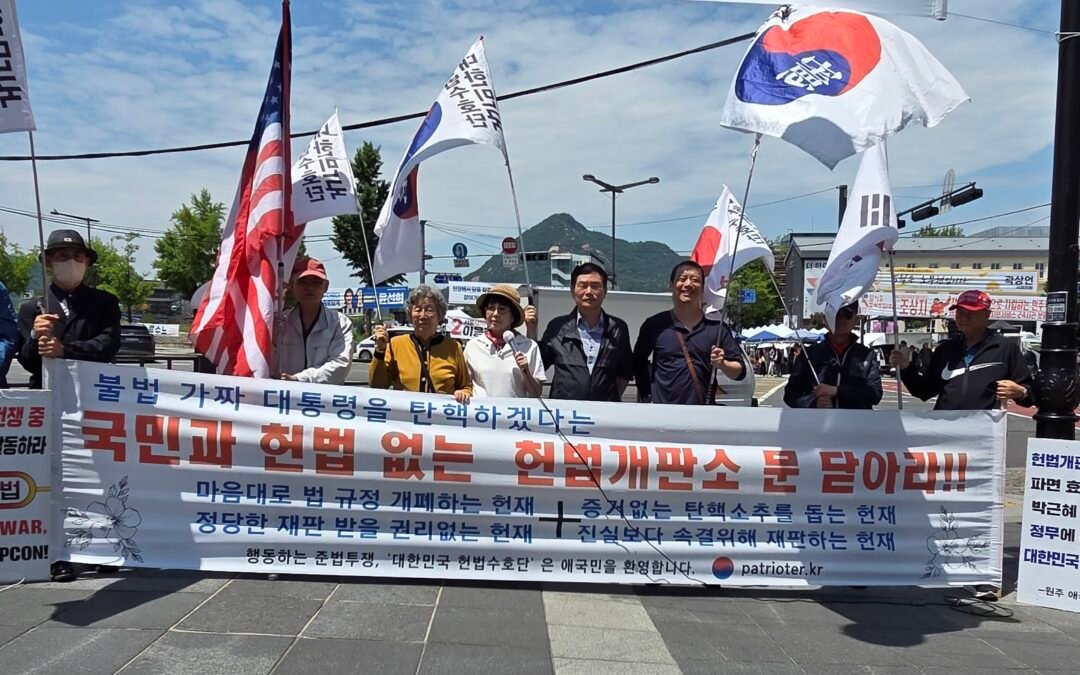

https://youtu.be/LX2NaT1KPYc?si=Lja78Alo4iX8SMpA
The Legal Necessity of Exercising Wartime Operational Control
– From the swamp of communism’s downfall, deliver salvation to the Republic of Korea !
전시작전권 행사의 법리적 당위성
- The Legal Consequence of Illegal Impeachment and Unlawful Regime
[1] Special Prosecutor Park Young-soo and the Seoul District Prosecutors’ Office unlawfully and unjustly submitted investigation records and audio files 13 times to the impeachment trial.
[2] The impeachment evidence did not meet the legal standard of proof, relying only on false media rumors.
[3] The impeachment resolution was arbitrarily modified and submitted as a “preparatory brief” without re-approval by the National Assembly, violating Article 95 of the National Assembly Act.
[4] The impeachment of a president without treason or foreign collusion excluded the supreme Constitution and was a rebellion based on the subordinate Constitutional Court Act.
[5] The justices instructed modification of the impeachment bill, committing instigation of forgery of official documents.
[6] They evaded the duty of appointment under Article 6 of the Constitutional Court Act and deliberately failed to form the full bench under Article 22.
[7] With only eight justices, who could only “hear” cases, they violated Article 23 by proceeding to “decide” in a deficient bench.
[8] The Court assisted the prosecutors, violating Article 32 by using illegally collected evidence to unjustly remove the president.
[9] As a president without treason or foreign collusion, even the Constitutional Court gravely infringed upon the people’s right to trial.
[10] They retroactively applied the Improper Solicitation and Graft Act, which came into force after the alleged acts, making the impeachment unlawful.
[11] The impeachment trial violated the essence of the constitutional right to a fair trial and contravened general principles of law.
[12] The justices, who should have judged independently according to conscience under the Constitution and law, unanimously voted for impeachment in a mob trial style.
[13] Even the judges, who should have remained neutral, acted as another team of prosecutors. It was not a normal judicial structure, but a two-to-one conspiracy of rebellion.
The unlawful impeachment did not recognize that President Park Keun-hye was not lawfully impeached, removed, or vacant.
Nevertheless, they conducted a presidential election that was null and void, issued a certificate of election to the majority vote-getter, and allowed an unlawful false republic to seize power.
On May 9, 2017, they held a by-election within 60 days of the supposed vacancy, but granted Moon Jae-in a full five-year term as if it were a regular election, expanding the opportunity for unlawful rule.
The National Election Commission claims there is no basis in the Election Act to judge the validity of the election, but under the higher law of Article 7 of the Constitution, responsibility to the people arises, and the chain of unlawful acts constitutes participation in constitutional disorder and rebellion.
On the carpet laid by the National Assembly, the Constitutional Court, and the NEC, Moon Jae-in, Yoon Suk-yeol, and Lee Jae-myung entered unlawful, invalid presidential elections, obstructed official duties by deceit, and received certificates of election.
They unlawfully imprisoned the lawful president, disabled her authority, arbitrarily enacted and repealed laws, and relocated or abolished institutions.
As illegitimate heads of regime, they arbitrarily mobilized political appointees, misappropriated national finances, and used them for ruinous projects.
For nine years, they unlawfully seized national sovereignty and inflicted harm on the state and the people through illegal rule.
The 13 key issues of unlawful impeachment, the NEC’s violation in managing the by-election, and the legal disqualification of subsequent rulers together form a consistent legal framework of organized acts with the purpose of constitutional disorder (rebellion) under criminal law.
- Invalidity of Unlawful Rule
Based on the theory of original nullity of impeachment, the major state acts that occurred after March 10, 2017 are described in detail as legally invalid and unlawful.
1) Non-existence of the Impeachment Decision and Legal Status
The Constitutional Court deliberately failed to form a nine-member bench (violating Article 6 of the Constitutional Court Act), and issued a removal decision in a deficient state without authority. Legally, this is “non-existence” or “null and void.”
President Park Keun-hye was not lawfully impeached, and therefore even after March 10, 2017 she remained the lawful president of the Republic of Korea.
Her unlawful arrest, indictment, and imprisonment constituted the criminal elements of unlawful detention and rebellion under the Criminal Code.
Obstruction of authority: Disabling the lawful president’s powers and driving her out was itself an act of constitutional disorder, forcibly suspending the functions of a constitutional institution.
2) Absolute Nullity of the By-election and Subsequent Presidential Elections
The presidential election held on May 9, 2017, which elected Moon Jae-in, was invalid because the premise of “removal” was null. There was no lawful basis to hold the election.
Examining the illegality of election management: Article 68(2) of the Constitution requires an election within 60 days only in the case of a lawful vacancy. A by-election based on unlawful removal lacked procedural legitimacy.
Furthermore, granting the by-election winner a full five-year term, instead of a shortened term, was a direct violation of the Public Official Election Act and the Constitution, amounting to unlawful expansion of power.
Each subsequent presidential election that elected Moon Jae-in, Yoon Suk-yeol, and currently Lee Jae-myung was invalid.
They entered elections without lawful basis, received certificates of election, and thereby usurped the highest state authority through deceit and obstruction of official duties.
They were not lawful presidents, because the lawful president had not been removed, impeached, or vacated.
3) Invalidity of Appointments of Political Collaborators and State Acts
All ministers, vice ministers, directors, chiefs, chairpersons, and secretaries appointed by the head of the unlawful regime (the ringleader) never acquired the legal status of “public officials.”
The appointing authority itself in the Presidential Office (Blue House) or central government was unlawful, and even local government elections under that regime were conducted under its unlawful supervision.
Therefore, all elections held under them, appointments made by the ringleader without lawful authority, and all legislative, administrative, and judicial acts, laws, orders, rules, and ordinances enacted by those mistakenly believed to have authority are legally null and void.
The execution of the national budget by these unlawful actors, without proper deliberation and promulgation of the budget bill, can be regarded as misappropriation of the treasury and breach of trust.
The salaries they received may be subject to the legal principles of embezzlement or unjust enrichment.
The question of whether such unlawful appointments and inaugurations involved disqualification must be judged according to the laws in force at the time.
If disqualification existed, then even if the state failed to recognize it due to its own error, the act of inauguration is deemed null and void under numerous Supreme Court precedents.
Such nullity can be asserted at any time, in any place, by anyone, without restriction of form.
The Constitutional Guardians Association has consistently denounced Moon Jae-in, Yoon Suk-yeol, and Lee Jae-myung as unlawful ringleaders of rebellion after President Park.
This was acknowledged in the spring and summer of 2024, when 13 conscientious ministers and vice ministers under the Yoon Suk-yeol regime submitted resignations, which served as a small proof of the legal validity of the claim of impeachment nullity.
At the same time, reports of Prime Minister Han Duck-soo’s resignation also arose from petitions submitted by the Constitutional Guardians Association.
4) Invalidity of Anti-Constitutional Legislation and Institutional Changes
For example, the Corruption Investigation Office Act and amendments to the Prosecution Act (removal of investigative powers) enacted by the unlawful regime were used as tools to achieve the purpose of constitutional disorder.
The Corruption Investigation Office, hastily created without constitutional basis or lawful authority of appointment, is invalid, and the law establishing it must be abolished and the office immediately closed.
Legislation depriving prosecutors of investigative powers, even if passed through the procedures of the National Assembly, was a means of constitutional disorder and therefore legally null and void, not entitled to legal protection.
Relocating or abolishing central state institutions without the approval of a lawful president was also an extension of rebellion that paralyzed state functions, and all such relocations must be restored to their original state.

- Nine Years of Unlawful Rule and the Logic of Constitutional Protection
Ultimately, since March 10, 2017, national governance has not been the normal operation intended by the Constitution, but a period of “unlawful occupation” by rebellion through hierarchy and coercion.
Because of the nullity of impeachment and “removal,” neither Moon, nor Yoon, nor Lee, nor anyone else could lawfully be president. If one realizes that the cry of “Yoon Again” has no persuasive legal basis and its hidden intent, it cannot continue.
The ringleader regime of national ruin, the state power that obeyed them, and the people of Korea who accepted it without thought — all of this makes “popular sovereignty” nothing more than empty words.
Thus, by recognizing them as presidents through “operations packaged as peace,” “candlelight frenzy,” “anti-Moon coalition,” and “Yoon Again,” people collaborated, giving them time to continue their ruinous work.
The abuse of state power reached its peak, and beyond the thoughtless acceptance of such ringleader-presidents, Yoon Suk-yeol — in fact an unlawful, illegitimate president — committed “rebellion” by declaring martial law.
This ringleader cartel rebel, Yoon Suk-yeol, who is neither president nor public official, was even subjected to baseless impeachment proceedings by the unlawful National Assembly and Constitutional Court, producing international disgrace and ridicule.
Thus, public attention was misdirected, and the people’s proper awareness malfunctioned, leaving the Republic of Korea in a state of absence of lawful authority.
(1) Legal Status of the Unlawful Regime
All laws enacted, rulings delivered (especially criminal trials related to President Park), and administrative acts carried out over the past nine years are “null facts” without any legal effect.
(2) Constitutional Duty of the People
Under Article 7 of the Constitution, public officials and citizens have the right and duty to end this state of constitutional disorder and return to the lawful constitutional order as it existed before March 10, 2017. Constitutional protection is the mission of the people.
(3) Legitimacy of Invoking Wartime Operational Control
Through irregular warfare operations, the ringleaders’ schemes of national ruin deceived state power and the people into a nationwide legal error, and the sovereign authority of the lawful president was brutally stolen.
In this national emergency that has lasted nine years, in a situation of rebellion continuing as “irregular warfare,” invoking wartime operational control under the Korea-U.S. Mutual Defense Treaty is interpreted as a legitimate measure to restore constitutional order and defend sovereignty.
This sequence — “unlawful impeachment → invalid election → seizure of governance by ringleader regimes” — clearly supports the legal conclusion that these acts directly constitute rebellion and constitutional disorder under criminal law.
- Constitutional Disorder as Rebellion
This matter must be reconsidered in detail, connecting it with criminal charges, to show why it is subject to “nullity.”
1) Legal Basis
◉ Criminal Code Article 87 (Rebellion): Anyone who raises a riot with the purpose of excluding state power or disturbing the constitutional order in all or part of the territory of the Republic of Korea shall be punished according to the following categories:
① The leader shall be sentenced to death, life imprisonment, or life confinement.
② Anyone who participates in conspiracy, directs, or engages in other important duties shall be sentenced to death, life imprisonment, or imprisonment of not less than five years. The same applies to those who commit acts of killing, destruction, or plunder.
③ Anyone who merely follows or participates in the riot shall be sentenced to imprisonment or confinement of not more than five years.
◉ Criminal Code Article 91 (Definition of Constitutional Disorder): The purpose of disturbing the constitutional order means any of the following:
① Destroying the functions of the Constitution or law without following the procedures prescribed by the Constitution or law.
② Overthrowing or making impossible the exercise of authority of a state institution established by the Constitution through coercion.
2) Charge of Power Usurpation by Constitutional Disorder
Upon reconsideration, the core of rebellion under the Criminal Code is “constitutional disorder,” meaning forcibly overthrowing or disabling the functions of constitutional institutions.
The structure of “constitutional disorder rebellion” is that the National Assembly, the Constitutional Court, and the National Election Commission seized power through unlawful impeachment and elections, excluded the lawful president, and infringed upon the rights of the people.
By disabling the authority of the president, the highest constitutional institution, and unlawfully altering state governance, they formed the legal logic that meets the requirements of “constitutional disorder rebellion” under the Criminal Code.
Among the many illegalities of the impeachment, especially the decision carried out without forming the nine-member full bench required by the Constitution and the Constitutional Court Act, was an act of self-destruction of the Constitutional Court’s authority, the last bastion of constitutional protection.
Removing the president through these illegalities was a “legal coup d’état” disguised as impeachment procedure, and the starting point of constitutional disorder.
Thus, President Park Keun-hye, whose impeachment itself was null, remains in office or must at least be accorded lawful treatment.
Nevertheless, her arrest, indictment, trial, imprisonment, and detention by unqualified persons constitute crimes of abuse of authority and unlawful detention under the Criminal Code.
The forced auction of seized property also has no legal effect.
3) Absolute Nullity of Elections and Appointments under the Unlawful Regime
One of the fundamental principles of civil and administrative law is that “a person without rights cannot confer rights.”
(1) Illegality of Elections: If the regime itself is the product of constitutional disorder, then all presidential elections (19th, 20th, 21st) and other public elections conducted under its management are legally baseless acts.
(2) Nullity of Election Results: Public officials elected through unlawful procedures have no legal existence, and all their acts of governance and promulgation of laws are null and void.
(3) Invalidity of Legislative Acts by Political Officials: Laws such as the Corruption Investigation Office Act and amendments to the Prosecution Act are invalid because they were produced from the root of rebellion.
From the criminal root of rebellion (the poisonous tree), all laws and institutions (the poisonous fruit) cannot be valid.
For example, altering the national investigative system without lawful constitutional authority was an act of constitutional destruction.
Therefore, the establishment of the Corruption Investigation Office was not law but merely an “unlawful occupied institution,” subject to immediate nullification without legislative procedure.
The amendments to the Prosecution Act (such as removal of investigative powers) are likewise null, as they were means to achieve constitutional disorder and must be immediately invalidated by a lawful regime.
4) Legally “All Their Acts Were Unlawful”
Viewing all governance since March 10, 2017 as a “period of unlawful occupation,” the following legal conclusions arise:
① Retroactive Nullity: All contracts and regulations enacted by the unlawful regime were null from the moment of execution, enforced only by physical coercion.
② Duty of Restoration: From the perspective of constitutional protection, the state must immediately return to the lawful condition before March 10, 2017, and all unconstitutional laws enacted since then must be treated as nonexistent without separate repeal procedures.
③ Criminal Punishment: Political officials and judicial/legislative actors involved in this process cannot escape criminal liability for rebellion and constitutional disorder.
The focus of this view is the maxim “Ex injuria jus non oritur” — illegality cannot create rights.
Although the current corrupted judicial system (courts, Constitutional Court, investigative agencies) does not recognize this, from the perspective of citizens defending constitutional values, this is a consistent and coherent legal logic.
The logic of constitutional protection is structured as: violation of mandatory public law → nullity of impeachment → existence of lawful President Park Keun-hye → invalidity of subsequent elections and governance → “constitutional disorder rebellion.”

- Conclusion
The legitimacy of the state clearly lies in constitutional continuity.
However, all state operations after March 10, 2017 reach the conclusion of being fundamentally null and void under the principle of constitutional protection, and since that day the Republic of Korea has fallen into a “legal vacuum.”
Here I must point out to the people: in the impeachment crisis of President Park, unjust forces incited the frenzy of candlelight mobs, who shouted victory at the sound of “removal.”
And then, unable to call the main enemy the main enemy, they elected Moon Jae-in in the presidential election, who harbored the sinister “great cause” of national ruin.
Even though a lawful president clearly existed, the elections that elected Moon Jae-in, Yoon Suk-yeol, and Lee Jae-myung were unlawful elections that should never have been held.
Some may argue that since the elections were conducted by the state and many citizens voted, they must be valid.
But such elections, deceiving the people, are legally no different from a few people gathering and saying, “You be president.”
Clearly, by unlawful means they stole the rightful president’s seat and seized the state’s sovereign power, yet our people accepted their leader as “president.”
For nine years, under the guise of national policy, they plundered the nation toward ruin, dividing public opinion, destroying security, and worsening finances, and the people thought state power could be used that way.
Thus, those regimes were not the people’s presidents, nor were their acts lawful exercises of state power.
Led by plunder toward ruin, the people lost their president and saw state power seized, and now witness the collapse of national security.
The lawful president was imprisoned and her authority suspended, while rebels seized power not by law but by “deceit and rebellion” through unlawful impeachment procedures.
Therefore, the government, the National Assembly, and the judiciary we face today are in fact “power without authority.”
This is not merely a legal interpretation but a grave problem shaking the legitimacy and existence of the state itself, an unprecedented constitutional rupture in Korea’s history.
Taxes paid by the people over nine years, treaties signed by the state, and countless court rulings may all be subject to nullification.
This shows that the Republic of Korea as a community has lost its foundation of existence, and the unlawful regime has caused immense chaos.
The past nine years were not mere political conflict but a “national emergency” in which the constitutional system was entirely suspended and the president’s seat was usurped.
Not realizing that Korea continues under ringleader regimes of Moon, Yoon, and Lee, to discuss transfer of wartime operational control with them is dangerous folly.
Even now, only a minority of citizens recognize this, while the unlawful regime pushes forward with schemes of constitutional amendment to finalize irregular warfare.
This grave political and ideological threat has become reality.
If amendment succeeds, even U.S. forces stationed in Korea may withdraw, as in Vietnam or Afghanistan, retreating the front line of the free world.
Meanwhile, the people remain unaware they are robbed and unlawfully ruled, living under an “invisible war,” a state of irregular warfare.
Thus today must be seen as a “wartime state” requiring invocation of the Korea-U.S. Mutual Defense Treaty, for more dangerous than open war is the fact that the nation’s central nervous system (legislative, judicial, executive) has been completely seized by unlawful forces.
Appealing to wartime operational control is the natural instinct of survival for citizens as human beings.
Correcting this massive legal error and illegality is directly tied to the nation’s destiny and the people’s right to survival.
With internal self-correction paralyzed, even with allied help, the Constitution must be defended — this is a desperate patriotic appeal.
In the journey of constitutional protection, to correct these “immense matters,” the following values are crucial:
The power of record: Detailed arguments like the 13 issues will serve as strong evidence when history reevaluates and law is reestablished.
The Constitutional Guardians Association has published books, Why Did Korea Commit Unlawful Impeachment? and Constitutional Protection Is the People’s Mission, to preserve this record.
Citizen awareness: Under Article 1(2) of the Constitution, “Sovereignty belongs to the people, and all power comes from the people.” True constitutional protection is completed through the unity of awakened citizens.
Faith in rebuilding the rule of law: Upholding the principle that illegality can never create legitimacy (“Ex injuria jus non oritur”) will light the future of Korea.
To uphold and protect the constitutional values of the Republic of Korea, the Constitutional Guardians Association, the Institute for National Wealth and Military Strength, and all patriotic citizens standing with us, will remain fully dedicated and committed with our utmost devotion.
May 2, 2026
Park Sang-gu Representative,
Korea Constitutional Guardians Association (CGA)
Dae-heung Kim Representative,
Bukuk Kangbyung Research Institute
And All Patriotic Citizens of the Republic of Korea