
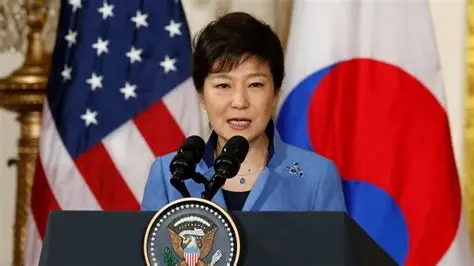
[Civil Diplomacy (Emergency National Security) Letter No. 7]
A Call to Restore the Legitimacy of South Korea’s National Security and a Warning Against the Traps of Northeast Asian Strategy
ㅡ 대한민국 안보와 동북아 전략의 함정 ㅡ
Dear friends who respect freedom, human rights, and the rule of law,
We address this letter to the officials of our allied nations and friends of the international community from the perspective of citizens who deeply value the constitutional legitimacy and national security of the Republic of Korea (ROK).
The purpose of this letter is to highlight the national security perspective and commitment to the ROK-U.S. alliance held by the legitimate President, Park Keun-hye, and to warn against the critical dangers that the illegitimate policies of subsequent regimes could bring.
The national security and alliance relations of a nation must never become tools for security experimentation, nor should they ever be used as instruments for political compromise or the preservation of a regime.
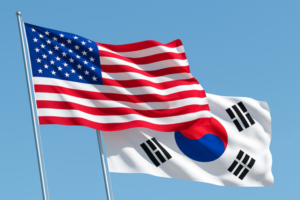
- President Park Keun-hye’s Perspective on National Security and the Alliance
President Park Keun-hye defined national security as the very foundation of citizens’ survival and happiness, emphasizing the ROK-U.S. alliance as a steadfast partnership that has defended freedom and peace.
Her policies secured both domestic and international trust based on constitutional legitimacy.
The security policies of President Park Keun-hye were firmly rooted in the constitutional legitimacy of the Republic of Korea and the values of liberal democracy.
On May 9, 2013, President Park Keun-hye stated the core essence of the ROK-U.S. alliance during her joint address to the U.S. Senate and House of Representatives as follows:
“Now, our precious ROK-U.S. alliance is moving toward a brighter world and a better future.“
“As such, the ROK-U.S. alliance is evolving into a comprehensive strategic alliance for the 21st century.”
“As long as the solid ROK-U.S. alliance remains intact, and the strong fundamentals of the Korean economy and the crisis management capabilities of the Korean government continue, North Korea’s provocations will never succeed.”
“I have long believed that the ultimate goal of the ROK-U.S. alliance must be to contribute to the happiness of all mankind.”
“Now is the time for the ROK-U.S. alliance to take a step further from defending freedom and peace on the Korean Peninsula and embark together on a journey toward a peaceful and happy unified Korea for both the South and the North.“
This was a historic message that engraved the meaning of the 60th anniversary of the alliance upon both nations, revealing President Park’s outlook on national security and her perception of the alliance.
It emphasized a security foundation, economic and strategic evolution, and ultimately, the goal of contributing to the happiness of humanity.
Under the conviction that “peace is not begged for, but protected by strength,” this principled deterrence policy against North Korea consistently maintained the “Trustpolitik” process—resolutely retaliating against North Korean provocations while engaging in dialogue only when North Korea chooses the path of denuclearization.
She elevated the ROK-U.S. alliance beyond mere military necessity to a “blood alliance” and a “value alliance.”
Decisions such as the deployment of THAAD (Terminal High Altitude Area Defense) were the results of defending the Constitution, prioritizing the security of the alliance despite intense pressure from neighboring countries.
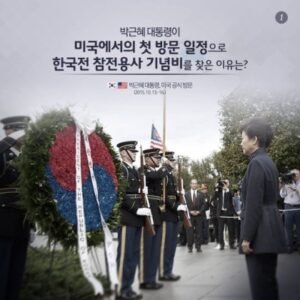
- The Illegitimacy and Dangers of Security Debates by Subsequent Illegal Regimes
The subsequent regimes of Moon Jae-in, Yoon Suk-yeol, and Lee Jae-min following President Park Keun-hye have faced constant criticism regarding their constitutional legitimacy, both in their inception and their operation.
The Moon, Yoon, and Lee regimes pushed forward security and alliance policies amidst lingering questions over their constitutional legitimacy.
A security policy pursued by a regime with vulnerable legitimacy inherently contains the following fatal dangers:
These regimes sought to push for the transfer of wartime operational control (OPCON) or alter the nature of the alliance in their respective ways.
These approaches were carried out without constitutional procedures and public consensus, thereby possessing inherent defects in policy legitimacy and stability.
This was a deceptive artifice (奸計) designed to overturn security policies for the sake of the regimes’ approval ratings or political ideologies—deceiving the public instead of securing public consensus, entirely ungrounded in the Constitution.
Such deceptive actions inevitably cause confusion for allied nations and severely tarnish the credibility of the state and its policies.
A submissive peace that relies on the disguised goodwill of North Korea, or actions that undermine the values of the alliance under the pretext of pragmatism, directly threaten the basic liberal democratic order explicitly mandated by the Constitution.

- The Traps and Dangers of the Wartime Operational Control (OPCON) Transfer
In particular, we warn that the current discourse on the “OPCON transfer” is not a simple matter of sovereignty, but a “strategic trap” that destroys the security balance in Northeast Asia.
These regimes packaged the OPCON transfer under the pretexts of “self-reliant defense” or “restoration of sovereignty.”
However, in reality, this creates a vacuum in deterrence and acts as a trap that benefits North Korea’s anti-American strategy and China’s regional hegemony.
There is a severe concern that the OPCON transfer will dualize or weaken the command structure of the ROK-U.S. Combined Forces Command (CFC), which possesses the world’s highest level of efficiency.
This is precisely the scenario that North Korea and the Chinese Communist Party (CCP) desire most.
If this OPCON transfer is carried out prematurely with an illegitimate regime, it is an undeniable fact that it will weaken the United States’ willingness to intervene on the Korean Peninsula in times of crisis and provide a pretext for the withdrawal of U.S. forces.
This will ultimately result in the communization of the Republic of Korea, pushing it under the sphere of influence of the CCP.
The OPCON transfer, driven as a deceptive artifice under the guise of “independence” by illegal forces lacking constitutional legitimacy who have effectively seized power, severs the cohesion of the alliance and leaves the Republic of Korea defenseless before North Korea’s nuclear threats.
Consequently, North Korea can exploit the OPCON controversy within South Korea for propaganda while demanding the withdrawal of U.S. forces and promoting anti-Americanism.
Furthermore, China can take the weakening of the ROK-U.S. alliance as an opportunity to expand its influence in Northeast Asia.
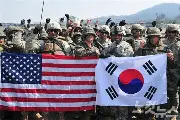
- The Fatal Threat of OPCON Transfer to the Indo-Pacific Strategy
What we specifically wish to warn against is the fact that the OPCON transfer currently pursued by the illegal forces inside the Republic of Korea is not merely an internal issue of the Korean Peninsula, but the starting point of a “strategic domino” that can collapse the entire U.S. Indo-Pacific Strategy.
1) Capitulation to the Chinese Communist Party’s (CCP) “Anti-Access/Area Denial” (A2/AD) Strategy
The CCP has long plotted the weakening of the ROK-U.S. alliance to block the influence of the U.S. military in Northeast Asia.
The OPCON transfer demanded by illegitimate regimes dismantles the world’s strongest integrated command system—the ROK-U.S. Combined Forces Command—thereby obstructing the rapid deployment of U.S. strategic forces.
This ultimately paves a highway for the CCP’s strategy to seize maritime and aerospace control in the Western Pacific, resulting in the subordination of South Korea, the linchpin of the Indo-Pacific region, under the influence of the CCP.
2) Handing Victory to the “Anti-American Front” Combining North Korea’s Nuclear Threat and CCP Hegemonism
North Korea’s anti-American policies and nuclear blackmail are ultimately aimed at the withdrawal of U.S. forces from Korea and the dissolution of the ROK-U.S. alliance.
The moment the OPCON transfer creates a rift in the combined defense posture, North Korea will seize the opportunity to make its nuclear threats blatant.
The CCP will back this from behind, erasing U.S. military influence from Northeast Asia.
This means the collapse of the frontline defense of the Indo-Pacific Strategy and a direct challenge to the free and open Indo-Pacific order built by the United States and its allies.
3) Deepening “Strategic Decoupling” Among Allies Within the Indo-Pacific Region
If the military solidarity between the ROK and the U.S. is damaged through the OPCON transfer, the United States will inevitably harbor skepticism about deploying reinforcement forces to Korea during a crisis.
This “decoupling” is the exact scenario North Korea and the CCP desire most, and it will sequentially weaken the security cooperation systems with regional allies, including Japan.
4) Collapse of the Alliance Link with Japan and the Regional Defense Network
Japan, as a core axis of ROK-U.S.-Japan security cooperation, heavily relies on the combined defense posture of South Korea and the United States.
If the military solidarity between the ROK and the U.S. weakens due to the OPCON transfer within Korea, Japan will face the risk of a loosened defense network against North Korean missile threats and Chinese maritime expansion.
This could trigger debates over independent nuclear armament or independent military reinforcement within Japan, deepening security instability across Northeast Asia.
Ultimately, the OPCON transfer will drive the Republic of Korea into security isolation, acting as a self-destructive act that severs the strongest link in the Indo-Pacific Strategy.
5) Extension of the Indo-Pacific Strategic Rift to the Weakening of NATO Alliance Links
Europe shares its security with the United States through NATO and has recently participated actively in the Indo-Pacific Strategy.
However, if the ROK-U.S. alliance weakens due to the OPCON transfer within Korea, the global deterrence and credibility of the United States will be shaken, causing NATO allies to question whether the U.S. defense commitment can truly be trusted.
This could lead authoritarian forces such as Russia, China, and North Korea to spread the message that “the U.S. alliance network is fragile,” thereby fostering division within Europe.
6) Summary
To summarize, an OPCON transfer pursued with forces lacking constitutional legitimacy is a dangerous gamble that destroys peace and stability in the Indo-Pacific region and offers the Korean Peninsula up to the totalitarian alliance of the CCP and North Korea.
The international community must coolly recognize the conspiracy of alliance destruction hidden behind the mask of “self-reliant defense” (The guise of ‘Self-reliant Defense’ used as a pretext for dismantling the alliance) worn by the current illegal regime in South Korea.
The international community must clearly see through the reality of the mask of “self-reliant national defense” being abused as an excuse for alliance dissolution.
- A Warning to the International Community
As previously reported, the security and alliance policies pursued by illegal regimes lacking constitutional legitimacy after President Park Keun-hye weaken public consensus and international trust, bringing risk to the strategic stability of allied nations.
Therefore, the international community must recognize that only policies based on constitutional legitimacy and public consensus within Korea can guarantee true stability and peace.
We state repeatedly that the impeachment proceeding against the legitimate President Park Keun-hye committed illegalities by deliberately violating numerous imperative provisions regarding procedural flaws, ignoring the Imperative Provisions of the Constitution of the Republic of Korea for state operation.
Thus, the legal effect of “dismissal” against President Park fundamentally failed to occur.
Because the President was not legally dismissed, there was no reason to hold subsequent presidential elections.
The Moon, Yoon, and Lee regimes are inevitably illegal regimes.
The emergence of these illegal regimes stems from anti-constitutional subversion of state governance, orchestrated by anti-state insurgent forces ensnared by the strategies and tactics aimed at communization (Red unification = Subversive strategies to undermine liberal democracy), which have continued against the Republic of Korea since North Korea’s Kim Il-sung.
Despite this being a rebellion to overthrow the state, the vast majority of the public failed to notice it because of:
(1) The legal manipulation under the guise of impeachment procedures,
(2) The illegal decisions executed by the Justices of the Constitutional Court,
(3) The deceitful media that covered up these questions, and
(4) The three groundless presidential elections conducted by the government to deceive the public.
These factors are the root culprits that have deceived both domestic and international audiences into accepting these illegal regimes to this day.

- In Conclusion
Even now, the national security perspective and commitment to the alliance held by the legitimate President of the Republic of Korea, Park Keun-hye, are defined as natural exemplars rooted in the constitutional legitimacy of the Republic of Korea.
Conversely, the discourse on the OPCON transfer put forward by illegitimate regimes is clearly a dangerous trap that benefits North Korea and China.
As evidence, the evisceration (emptying out) of the Constitution and laws utilized to pursue domestic division, security destruction, and fiscal deterioration has reached an unspeakable level since the inception of these illegal regimes.
The statement that the Republic of Korea has already become a lawless state where even the tripartite system of separation of powers has collapsed and basic legal common sense has vanished is an alarming fact of crisis, not an exaggeration at all.
The legal struggle against those regimes to restore constitutional order under the illegal regimes following President Park’s administration was met with irrelevant answers, proving to be a completely futile effort against deaf ears.
On the contrary, if the claims of our legal struggle had been an absurd legal logic failing to connect statutory laws and numerous past precedents, we would have already been imprisoned for spreading false rumors, defamation, or insult; yet, we continue our struggle relying on the remaining formal Constitution.
Furthermore, if there were any absurdity in this legal struggle, legal sanctions could have been imposed under any pretext, such as crimes of rebellion or foreign troubles.
However, we have rebuked them in various ways with legal logic so rigorous that it leaves no room for such sanctions.
We appeal to the international community and our allies to face the dangers of this deceptive security discourse conducted with illegal regimes, and to support the return to official duties of the legitimate President based on the constitutional legitimacy of the Republic of Korea, as well as a sound security and alliance policy for Korea.
May 16, 2026
With deepest respect,
Constitution Guardians of Korea (CGA)
Representative: Park Sang-gu
Institute for National Power and Prosperity (INPP)
Director: Kim Dae-heung
And all patriotic citizens of the Republic of Korea
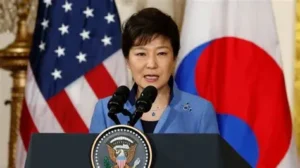
Park Geun Hye Addresses Joint Session of U S Congress
In this regard, we still share the legitimate President of the Republic of Korea Park Geun-hye’s perspective on national security and the ROK-U.S. alliance, and we review her speech delivered at the U.S. Congress on May 9, 2013.
https://youtu.be/QbzNh6OpG6s?si=ZSdavUW_AEojQWFv